
Sections on this page
- What is included in a new gutter installation?
- Which size gutter does a Sterling house need?
- Which material is best?
- How is a new gutter system installed?
- Words you will hear
- What does gutter installation cost?
- HOA approval
- When is the best time to install?
- Who decides the details
- Planning a new system eave by eave
- The first heavy rain
What is included in a new gutter installation?
A complete job covers more than the trough. It includes checking and repairing the fascia, adding drip edge where it is missing, forming the gutters, fitting corners, end caps and outlets, hanging everything on hangers, and installing downspouts with a planned place for each to empty. Guards can be added at the same time.
| Part | Job it does | Usual choice in Sterling |
|---|---|---|
| Gutter | Collects water along the eave | 5 or 6-inch seamless aluminum K-style |
| Clips | Fix the trough to the trim board | Concealed screw clips about 24 in apart |
| Outlets | Let water into the downspouts | Every 30 to 40 feet and near each valley |
| Pipes | Bring roof water down the wall | 2x3 for small roofs, 3x4 for big or shaded ones |
| Discharge | Where water ends up | Extensions, splash blocks or buried drains to pop-ups |
| Guards | Keep debris out | Micro-mesh under oaks and maples |
Which size gutter does a Sterling house need?
Single-story ramblers and split-levels in Sterling Park usually manage with 5-inch K-style and enough downspouts. Two-story colonials in Cascades, Countryside, Ashburn and South Riding typically need 6-inch on the larger rear roof, with 3x4 downspouts placed close to valleys. Townhouses can usually stay at 5-inch. Historic homes in Leesburg and Herndon often look best in half-round. More detail is on the 6-inch gutters page and in the sizing guide.
The deciding factor is often summer weather. Thunderstorms can drop a lot of rain in a short time, and a big two-story roof sends it all to one eave. A gutter that copes with steady rain can still spill in a downpour.
Which material is best?
| Material | Pros | Cons | Best fit |
|---|---|---|---|
| Aluminum, .032 inch | Never rusts; dozens of shades | A hard knock leaves a crease | Nearly every house |
| Aluminum, .027 inch | Lower price | Bends under ladders, snow and limbs | Sheltered single-story eaves |
| Galvanized or Galvalume steel | Strong | Rusts once the coating wears | Commercial and outbuildings |
| Copper, 16 or 20 oz | Decades of life, attractive patina | Expensive, can stain | Historic and high-end homes |
| Vinyl | Inexpensive | Brittle in cold, sags in heat | Sheds |
For the full comparison see the materials guide, plus seamless gutters, copper, half-round and downspouts.
How is a new gutter system installed?
- Measure each eave, mark corners and valleys and agree where every downspout will go.
- Inspect the fascia and replace soft boards before hanging anything.
- Add roof-edge flashing anywhere it is absent.
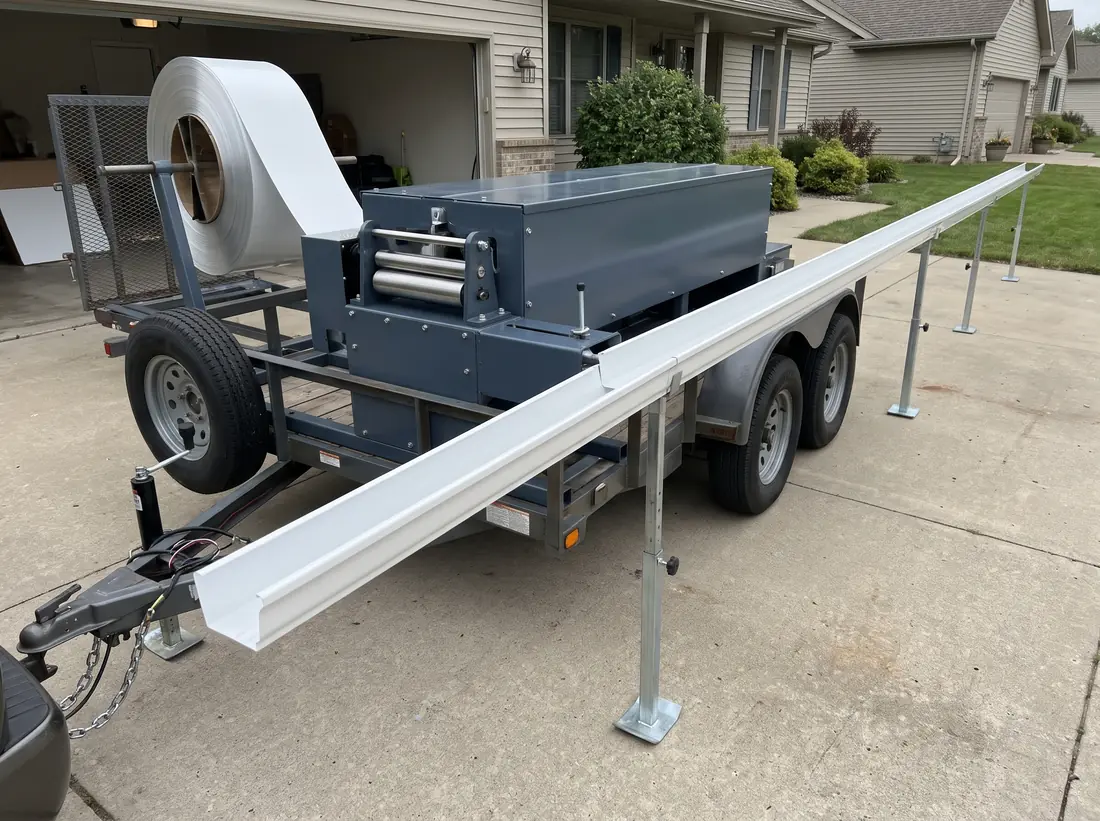
- Run each eave's length through the forming machine.
- Cut outlets, fit corners and end caps, and seal every joint.
- Hang the gutter on screwed hidden hangers with a gentle slope toward each outlet.
- Fit downspouts with elbows and straps, and route each to an extension, splash block or buried drain.
- Run water through every section and downspout to check the flow.
Words you will hear
| Word | Meaning |
|---|---|
| Drip edge | A bent strip of metal fixed along the roof edge so water jumps clear of the wood and lands in the gutter |
| Gutter apron | L-shaped metal tucked beneath the first shingle course, its lower leg hanging into the trough |
| Hidden hanger | A bracket concealed inside the gutter that is screwed through the back wall into the fascia |
| Outlet | The short tube through the trough floor that the pipe connects to |
| Elbow | A bent section that changes the pipe direction, either toward the wall or along it |
| Fall | The slight downward slope of a gutter toward its outlet |
| Coil | The roll of painted aluminum or steel fed through the seamless machine |
| Valley diverter | A small metal deflector placed in the gutter under a roof valley to calm the flow |
| HOA review | An architectural approval process many Loudoun communities require for exterior changes, including gutter color |
What does gutter installation cost?
Using Angi and This Old House national averages as a yardstick: 5-inch aluminum about $9–13 a fitted foot, 6-inch $12–18, copper $25–40. A rambler needs roughly 120 to 170 feet; a two-story colonial often 180 to 260. Height, corners, fascia repair, downspouts and guards all move the price. See the Sterling cost guide.
Rough out your price
$1,440 to $2,240
A planning figure drawn from national cost guides by Angi, This Old House. The real number depends on corners, downspouts, trim repair and access, and comes from a contractor who measures the house.
HOA approval
Many Loudoun communities, including Cascades, Countryside, Ashburn and South Riding, review exterior changes. Gutter color is often on the list. Get approval before the coil is ordered; the HOA guide explains how.
When is the best time to install?
Spring and early summer offer the most scheduling choice. Fall is busy because overflow becomes obvious once the leaves come down, and winter work depends on the weather.
Who decides the details
You do, with the contractor's advice. Trough width, color, pipe count and where each pipe ends are all choices worth talking through rather than accepting by default. A short walk around the house together, pointing at the problem spots, usually settles them in a few minutes.
Planning a new system eave by eave
The best installations treat each side of the house separately. The front might need only 5-inch gutter and two downspouts, while the rear, under a large roof and a valley, needs 6-inch and three or four drops. Garage eaves, porch roofs and bays each get their own look. Asking the contractor to walk the house with you and explain the plan for each eave makes the quote easier to understand and compare.
The first heavy rain
After installation, the first storm is the real test. Walk around during or just after it. Water should run along each gutter to its outlet, drop through the downspout and leave the extension well away from the wall. Corners should be dry. If anything drips or spills, call the installer while the job is fresh.