
Sections on this page
- Expected life
- Weights and shapes on offer
- How the color moves
- Installation order
- Copper vocabulary
- Price per foot
- Marks and metal clashes
- Where copper makes the most sense
- Using copper on part of the house
- Soldering and skill
- Patina and expectations
- Runoff and surfaces
- Looking after copper
- Copper and the rest of the roof
Expected life
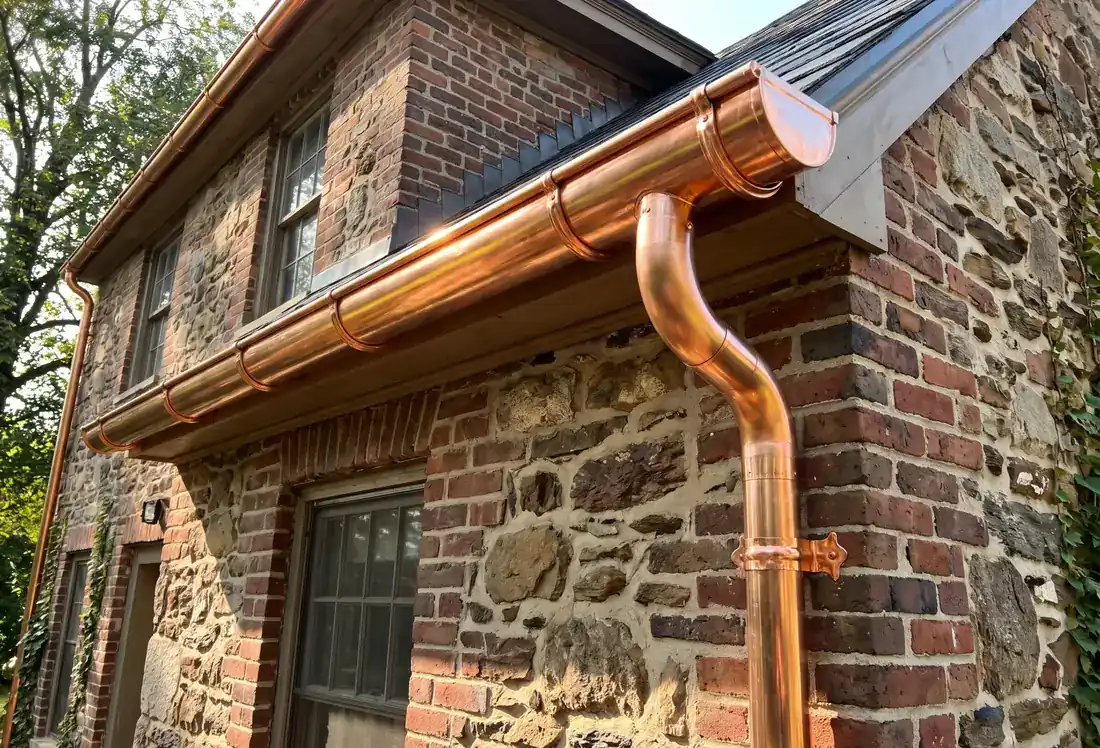
Soldered joints plus copper hardware let a system run for many decades. The metal cannot rust; its surface weathers into a film that shields what is underneath.
Weights and shapes on offer
| Choice | What to know |
|---|---|
| 16 oz sheet | Normal choice for houses |
| 20 oz sheet | Heavier, better on big or windy eaves |
| Half-round shape | Classic curve |
| K-style shape | Sharper, more modern line in copper |
| Round pipe | 3 or 4-inch with copper bands |
How the color moves
| Phase | Roughly when | Appearance |
|---|---|---|
| Fresh | Install day | Penny-bright |
| Darkening | Within months | Blotchy brown |
| Even | After a year or two | Deep brown all over |
| Verdigris | Many years on | Green to blue-green |
Installation order
- Fix the trim first; copper weighs more and wants solid wood.
- Space copper hooks or clips tightly.
- Set each length and solder the laps.
- Solder in the drops and caps.
- Hang round pipe on copper bands.
- Aim discharge away from pale paving and stone.
Copper vocabulary
| Word | Meaning |
|---|---|
| Gauge | How thick the metal is: .027 or .032 inch for aluminum, sold by weight per square foot for copper |
| Half-round | Open curved trough resting in hooks, typical of period buildings |
| Bracket | An exterior support, usually for half-round gutter, mounted to the fascia or the roof deck |
| Outlet | The short tube through the trough floor that the pipe connects to |
| Strap | The clip or band holding the pipe against siding or brick |
| End cap | The flat piece closing off each end of a run |
Price per foot
National cost guides place copper near $25 to $40 a foot fitted, set against about $9 to $13 for 5-inch aluminum (Angi, This Old House). Plenty of owners reserve copper for the porch, a bay or the street face.
Marks and metal clashes
Water off copper can tint pale stone, concrete and light siding green. Keep copper apart from aluminum and plain steel, and use only copper or stainless hardware.
Where copper makes the most sense
Copper is a long-term choice. It suits houses that are expected to stand for generations, historic buildings where the original gutters were metal, and custom homes where the eaves are a visible part of the design. Around Sterling that tends to mean estate homes in Great Falls, waterfront houses in Lowes Island and older buildings in Leesburg's historic district. On a typical 1980s colonial, aluminum usually gives better value.
Using copper on part of the house
Many owners use copper only where it is seen. A front porch roof, a bay window or an entry gable in copper, with painted aluminum elsewhere, gives much of the look for a fraction of the cost. The two metals must not touch. Copper runs need their own downspouts, and any aluminum nearby should be kept away from copper runoff, which can corrode it.
Soldering and skill
Copper joints are soldered, not sealed. A well-soldered seam is effectively permanent, but it takes practice to make neatly on a ladder. Ask how many copper jobs the installer has done, and whether you can see one. Fasteners, straps and brackets should be copper or stainless to avoid reactions between metals.
Patina and expectations
New copper shines for a short time, then darkens unevenly through browns before settling. The green patina most people picture can take many years, depending on exposure. Sheltered eaves change more slowly than open ones. If you want the bright color kept, it means regular cleaning and sealing, which most owners decide against.
Runoff and surfaces
Water from copper carries small amounts of the metal. Over time that can leave green marks on light stone, concrete walks and some siding. Directing downspouts onto gravel or planting beds, rather than onto pale patios, avoids most of it.
Looking after copper
- Clear leaves and seeds as with any gutter; copper does not clog less.
- Check soldered seams occasionally, especially after hard freezes.
- Keep aluminum flashing, ladders and fasteners from rubbing on the copper.
- Leave the patina alone unless you want the maintenance of polishing.
Copper and the rest of the roof
Copper works best when the flashing around it is copper or a compatible metal too. Aluminum drip edge under a copper gutter can corrode where the two meet, especially where water sits. On a re-roof, that is the time to match the flashing. On an existing roof, a contractor can add a copper apron that laps under the shingles and into the gutter, keeping the two metals apart. Ask how the roof edge will be detailed before the copper goes up, because changing it later means taking the gutter down again.