
Sections on this page
Picking a pipe size
| Pipe | Best on | Trade-off |
|---|---|---|
| 2x3 rectangle | Small, open roofs | Chokes on leaves sooner |
| 3x4 rectangle | Most two-story houses and treed lots | Lets seeds and leaves through |
| 3-inch round | Half-round on modest roofs | Period look |
| 4-inch round | Half-round on larger roofs | Higher flow |
Counting drops
A sensible rule is a drop at least every 30 to 40 feet of trough and one beside every valley. A long eave draining from one end pushes all its water past every clip and spills when the rain gets heavy.
Choosing where each pipe ends
| Yard situation | End treatment | Risk to check |
|---|---|---|
| Level lawn | Pad or extension reaching a few feet out | Soil that tips back to the wall |
| Basement below | Long extension or an underground line | Window wells nearby |
| Existing underground lines | Feed the line to a lawn emitter | Silted or crushed pipe |
| Space for planting | Pipe to a rain garden | Distance to the house |
| Hillside lot | Lead to firm ground | Gullies forming below |
More on this in gutters and wet basements.
Fitting sequence
- Settle drop positions before any trough is run.
- Cut the holes and caulk in the drop tubes.
- Use elbows to bring each pipe tight to the wall.
- Screw bands at intervals, into studs where you can.
- Add the foot elbow plus an extension, pad or drain hookup.
- Pour water through to confirm.
Downspout vocabulary
| Word | Meaning |
|---|---|
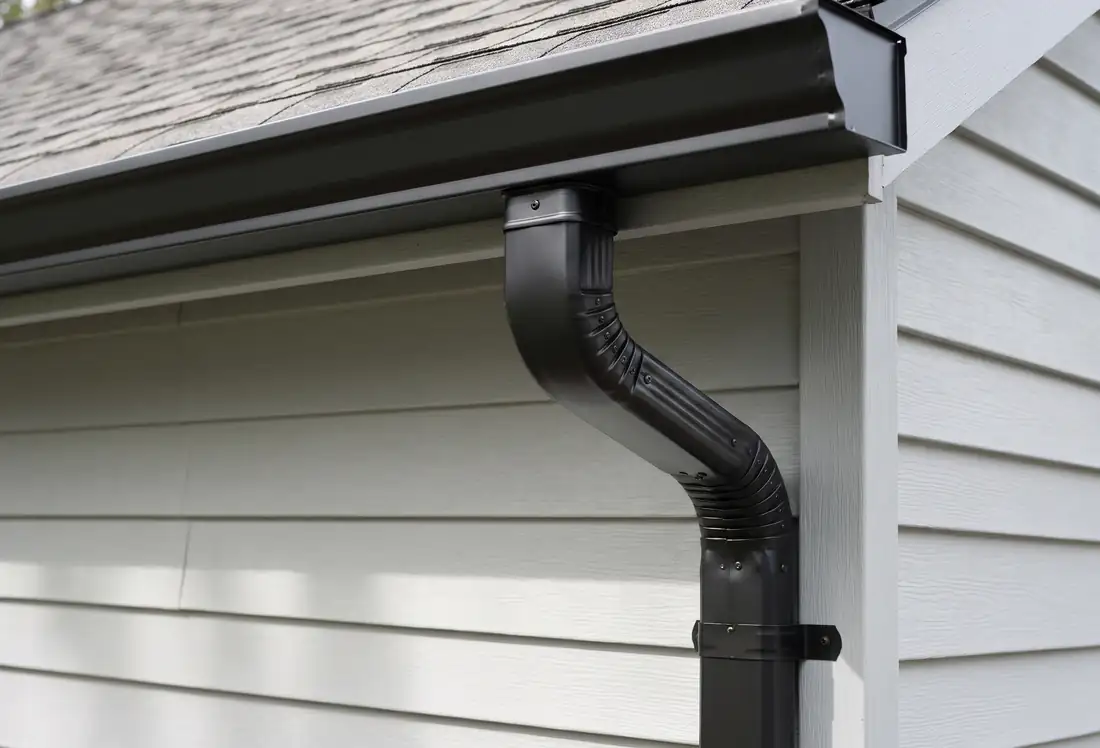
| Downspout | The vertical pipe taking water from the gutter to the ground |
| Elbow | A bent section that changes the pipe direction, either toward the wall or along it |
| Strap | The clip or band holding the pipe against siding or brick |
| Extension | An added length of pipe at the foot of the downspout that moves water away from the house |
| Splash block | A concrete or plastic tray that spreads downspout water across the lawn |
| Cleanout | A capped fitting at the pipe foot that gives access to the buried line for flushing |
| Buried drain | Corrugated or PVC pipe under the lawn that carries downspout water to a pop-up, curb or ditch |
| Pop-up emitter | A small lidded outlet at the end of a buried drain that opens when water pushes through |
Planting for roof water
Loudoun's Virginia Conservation Assistance Program helps fund runoff projects such as rain gardens. See rain gardens and VCAP.
The bottom of the downspout matters most
A gutter can be sized and hung perfectly and still cause trouble if its downspouts dump water at the foundation. Around Sterling, many homes have basements, and a single downspout emptying next to the wall can be enough to dampen one corner. The first question on any downspout job is where each one ends, then whether that spot sends water away.
Extensions, splash blocks and drains
A splash block is a sloped pad that spreads water and stops it digging a hole. It is fine on ground that already falls away from the house. An extension carries the water further out, usually several feet, and can be a fixed length or a hinged piece that flips up for mowing. A buried drain sends water underground to a pop-up emitter in the lawn or to a daylight outlet on a slope. Buried drains look tidy but need to be kept clear, and they are hard to check once grass grows over them.
Planning positions
On a new installation, downspouts are planned before the gutter is formed, because outlets are cut into the trough. Good positions are close to valleys, at the ends of long runs and where the ground below can take water. Poor positions are next to walkways that will ice in winter, beside window wells and at the corner where the patio slopes toward the house. Moving a downspout later means a new outlet and a patched hole, so it is worth getting right the first time.
Townhouse rows
On townhouses in Sugarland Run, Ashburn Village and similar communities, a downspout often has to land on a narrow strip of ground or a shared walk. Extensions that cross the walk are a trip hazard. Options include routing the downspout to the side yard, adding a short buried drain or using a downspout diverter into a rain barrel where the association allows it.
Straps and wind
Downspouts catch wind like a sail. Straps fixed into framing, not just siding, keep them on the wall through summer storms. Each elbow joint should be screwed so the sections do not separate when snow and ice slide down them.
Signs a downspout needs attention
- Water bursts out of a joint partway down in heavy rain.
- The gutter overflows right above the outlet.
- A puddle forms at the base and stays for a day.
- The downspout leans, rattles or has come away from the wall.
- A pop-up in the lawn never seems to open.