
Sections on this page
- Signs a house has outgrown 5-inch
- What local houses typically get
- Going from 5 to 6, step by step
- Sizing vocabulary
- The price step
- Does it look oversized?
- How to tell whether a 5-inch gutter is too small
- Valleys are where size matters most
- Not every eave needs the upgrade
- Hangers and weight
- Pairing with guards
Signs a house has outgrown 5-inch
The trigger is simple: more roof feeds an eave than its trough and drops can clear in a cloudburst. Locally that tends to be the back of two-story colonials, any run below a valley, steep pitches and eaves shaded by big trees. Steady drizzle proves nothing here. A July thunderstorm is what shows whether the system keeps up.
| What you see | 5-inch is usually enough | Lean toward 6-inch |
|---|---|---|
| Roof sloping to that eave | Modest | Big rear plane |
| Steepness | Gentle | Sharp |
| Valleys above | None, or one near a drop | Two or more |
| Room for drops | Plenty of spots | Very few spots |
| Canopy | Clear sky | Oak or maple overhead |
| Stories | Single | Two |
What local houses typically get
| Home | Trough | Drop size |
|---|---|---|
| Two-story colonial, Cascades or Ashburn | 6-inch K-style | 3x4 |
| Big house, Lowes Island or Great Falls | 6-inch with added drops | 3x4 |
| Sterling Park rambler | 5-inch | 2x3 or 3x4 |
| Sugarland Run townhouse | 5-inch | 2x3 |
Going from 5 to 6, step by step
- During a downpour, note exactly where water jumps the front edge; on a dry day, look for splash scars.
- Ask whether a couple of extra drops would cure it without a new trough.
- Pull the old runs and probe the trim behind them.
- Run new 6-inch lengths and fix them on screws.
- Hang 3x4 drops, adding one under each valley.
- Carry the discharge clear of the foundation and hose-test.
Sizing vocabulary
| Word | Meaning |
|---|---|
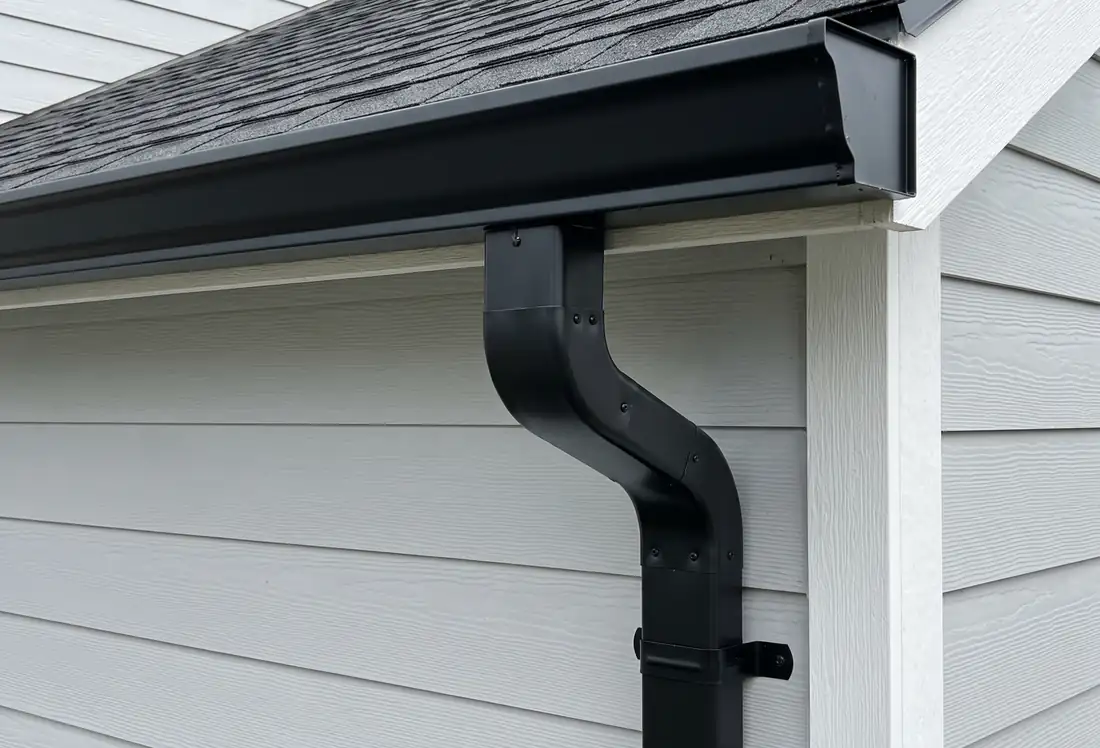
| K-style | The everyday shape, square-backed with a decorative front that echoes crown trim |
| Outlet | The short tube through the trough floor that the pipe connects to |
| Valley diverter | A small metal deflector placed in the gutter under a roof valley to calm the flow |
| Downspout | The vertical pipe taking water from the gutter to the ground |
| Fall | The slight downward slope of a gutter toward its outlet |
| Drip edge | A bent strip of metal fixed along the roof edge so water jumps clear of the wood and lands in the gutter |
The price step
Going by national figures, 6-inch seamless aluminum runs about $12 to $18 per foot fitted, against roughly $9 to $13 for the narrower size (Angi, This Old House). The bigger drops add a little too.
Does it look oversized?
On a two-story wall, hardly ever, and less so in a trim-matched shade. On a low rambler you can keep 5-inch out front and use 6-inch only at the back. More detail in the sizing guide.
How to tell whether a 5-inch gutter is too small
Overflow is not always a size problem, so the first job is to rule out the cheap causes. A clogged outlet, a sag that holds water in the middle of a run or a downspout blocked at its bottom elbow will all make a 5-inch gutter spill. If those are clear and the gutter still sheets water over the front during a summer thunderstorm, the run is probably carrying more roof than it can handle. Signs to look for on a dry day include a line of splash marks or worn mulch below the eave, staining on the siding under the front lip and a trench in the soil under one stretch of gutter.
Valleys are where size matters most
Where two roof planes meet, the valley gathers water from both and delivers it to a short length of gutter at speed. On many colonials in Cascades, Ashburn and South Riding the rear eave sits under one or two valleys, and the stream can jump straight over a 5-inch front lip. A 6-inch profile gives the water more room to turn, and a downspout placed right below the valley keeps the stream short. A small valley diverter in the gutter can help too.
Not every eave needs the upgrade
Front porches, garage eaves and the short sides of a house often have little roof above them. Changing those to 6-inch adds cost without adding much. A common approach is 6-inch on the large rear planes and any eave under a valley, with 5-inch elsewhere in the same color. From the street the difference is hard to see, especially on a two-story wall.
Hangers and weight
A full 6-inch gutter is heavier than a full 5-inch, and wet leaves and snow add more. Screwed hidden hangers set at close spacing into sound fascia carry it. If the existing fascia is soft, it needs replacing before the larger gutter goes up, otherwise the new system starts to droop within a season or two.
Pairing with guards
Mesh guards are made for 6-inch gutters as well as 5-inch. Under oaks, the combination of a larger trough, 3x4 downspouts and fine mesh cuts down both overflow and cleaning. Ask for prices with and without guards so the two can be compared.