
Sections on this page
- Matching a guard to Sterling trees
- Guard fitting, step by step
- Guard vocabulary
- Do guards pay off?
- Do guards need maintenance?
- Guards and snow
- HOA rules
- Why guards are popular around Sterling
- What guards do not do
- Guards on new and existing gutters
- Fastening for wind and snow
- Checking guards each year
- Guards and roof work
- Choosing between brands
- Pricing guards fairly
- Guards and resale
- A quick test after fitting
Matching a guard to Sterling trees
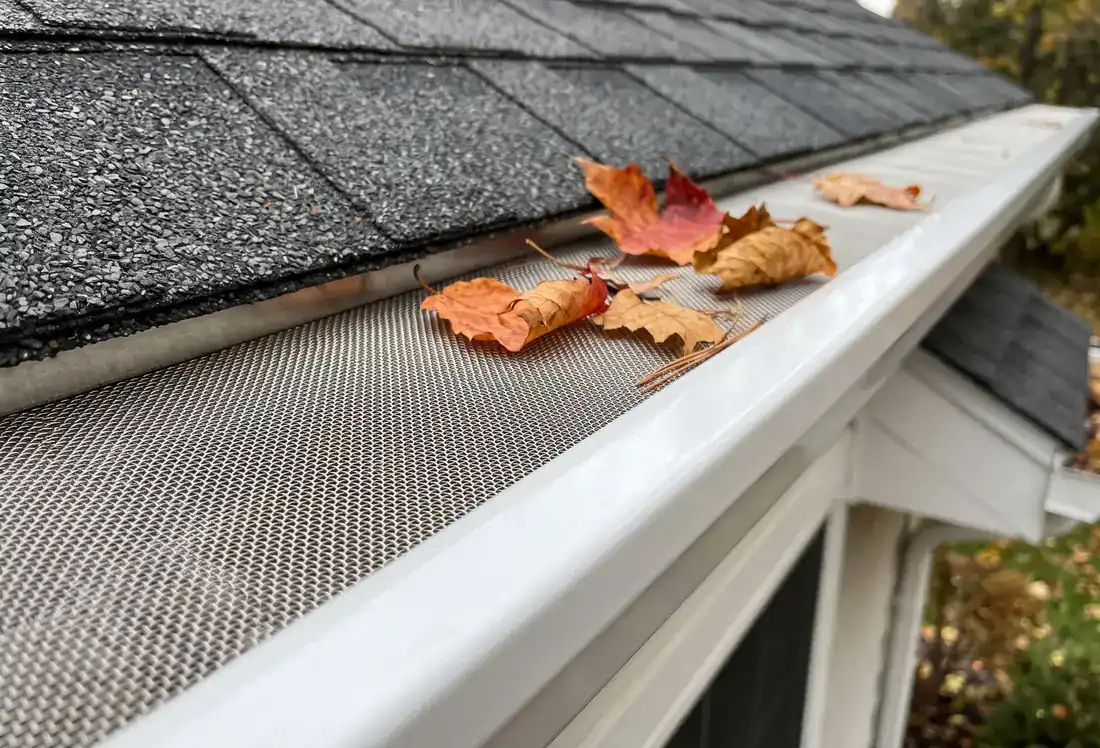
For most homes under oaks, maples and tulip poplars, fine stainless micro-mesh is the best performer because it stops both leaves and the small debris (oak flowers, maple seeds, pine needles) that slips through coarser guards. Perforated covers and hoods do well with big leaves. Foam and brush inserts tend to trap debris and need frequent cleaning.
| Guard | Oak flowers and seeds | Leaves | Price level |
|---|---|---|---|
| Stainless micro-mesh | Kept out | Kept out | Higher |
| Perforated cover | Some get through | Kept out | Middle |
| Reverse-curve hood | Some collect at the lip | Shed well | Higher |
| Screen | Pass through | Mostly kept out | Lower |
| Foam or brush insert | Trapped in the insert | Sit on top | Lower |
See micro-mesh gutter guards, gutter guard types and the guide on guards for oak and maple.
Guard fitting, step by step
- Clean the gutters and flush every downspout.
- Fix sags, leaks and soft fascia first.
- Choose a mount: beneath the shingles, clipped to the front lip, or screwed to the trim.
- Trim each panel and join them cleanly at miters and below valleys.
- Screw panels down so gusts and snow cannot shift them.
- Pour water over the guard to check it gets through.
Guard vocabulary
| Word | Meaning |
|---|---|
| Micro-mesh | Fine stainless mesh over a frame that blocks small debris like oak flowers and pine needles |
| Perforated cover | A guard with punched holes that lets water through |
| Reverse curve | A hood-style guard where water wraps around a curved lip into the gutter |
| Gutter apron | L-shaped metal tucked beneath the first shingle course, its lower leg hanging into the trough |
| Outlet | The short tube through the trough floor that the pipe connects to |
| Ice dam | A ridge of ice along the eaves that holds back meltwater after snow |
Do guards pay off?
| Question | If yes | If no |
|---|---|---|
| Do oaks, maples or tulip poplars overhang the roof? | Guards save repeated cleanings | Less benefit |
| Is the house two stories or more? | Each cleaning is harder and costs more | Cleaning is quick |
| Do gutters overflow between cleanings? | Guards may stop it | Current routine works |
| Are the troughs solid and pitched right? | Good to go | Repair or renew them before guards |
Pricing is per foot of trough. Fine mesh costs more than screens, but on a two-story house under trees it often pays for itself in avoided cleanings within a few years.
Do guards need maintenance?
Some. Pollen, seed and small leaf fragments can build up on mesh, especially in spring. Brushing or hosing the surface a couple of times a year lets rain back in. Watch it during the first big storm after leaf fall.
Guards and snow
Snow can sit on guards and slide off the roof in sheets. Guards that are firmly fastened stay put; loosely clipped ones can be pulled off. The January 2016 blizzard is a reminder that fastening matters.
HOA rules
Guards are usually visible from the street, so some associations want to approve them. Check before ordering.
Why guards are popular around Sterling
Many neighborhoods around Sterling were built thirty to sixty years ago, and the trees planted then, or left standing, now tower over roofs. Oaks, maples, tulip poplars and pines drop something for much of the year. On two-story houses, each cleaning means a tall ladder or a paid visit. Guards reduce how often that happens, which is why they are one of the most common requests on this line.
What guards do not do
Guards do not fix leaks, sags or undersized gutters. They do not stop ice in winter. They do not remove the need for any maintenance; even fine mesh needs an occasional brush. And they do not make a failing gutter last longer. Expect guards to cut cleaning, not to remove it.
Guards on new and existing gutters
Fitting guards at the same time as new gutters is the simplest approach, because the gutter is clean, straight and sound. On existing gutters, the installer should clean, check and repair first. If the existing system is near the end of its life, it may be better to replace the gutters and add guards together.
Fastening for wind and snow
Summer storms and sliding snow put loads on guards. Guards screwed to the gutter or fascia stay in place better than those that simply clip on. Ask how the guard is fixed and what happens on eaves where snow slides off every winter.
Checking guards each year
- Look from the ground for debris piled on top after leaf fall.
- Watch in a heavy rain for water overshooting the front.
- Check corners and valleys for gaps.
- Make sure outlets and downspouts still flow freely.
- Brush off any spring pollen mat that slows water.
Guards and roof work
If the roof is going to be replaced soon, plan the guards around that. Some guards slide under the first row of shingles and would need to come off for a re-roof. Fitting them after the new roof is on avoids paying for removal and reinstallation.
Choosing between brands
Many brands of mesh guard look similar but differ in mesh fineness, frame strength and how they attach. Some are sold only through specific installers. Rather than choosing by brand name, compare the mesh material, the frame, the fastening method and how corners are handled. Ask to see a sample, and if possible look at a house where the same product has been on for a few years. A guard that has kept its shape and stayed fixed through several winters is a good sign.
Pricing guards fairly
Guards are priced per foot, but corners, valleys and downspout areas take extra time. Make sure quotes cover the same footage and include the same prep work.
Guards and resale
Some buyers see guards as a plus, particularly on two-story homes under trees. Keep any product information and warranty papers with the house records so they can be passed on if you sell.
A quick test after fitting
Run a hose onto the roof above a guarded eave and watch the water enter the mesh and leave the downspout.