
Sections on this page
- Houses that suit the profile
- How it differs from K-style
- The pieces involved
- Fitting sequence
- Half-round vocabulary
- Choosing the metal
- Town review
- Carpentry comes first on older houses
- Brackets and spacing
- Capacity and downspouts
- Joining sections
- Mixing profiles on one house
- Questions to ask
- Looking after half-round
Houses that suit the profile
Older buildings, and newer ones built to look older. Leesburg's historic district went onto the National Register in 1970, and plenty of its buildings would look wrong with anything else. Custom homes along the river in Great Falls and Lowes Island use it as well, often in copper.
How it differs from K-style
| Trait | Half-round | K-style |
|---|---|---|
| Look | Soft curve, period feel | Flat back with a molded face |
| Held up by | Visible brackets | Concealed clips |
| Water held at equal width | Lower | Higher |
| Matching drops | 3 or 4-inch round pipe | 2x3 or 3x4 rectangle |
| Usual construction | Lengths joined on site | One piece from a machine |
| Relative cost | More | Less |
The pieces involved
| Component | Job it does |
|---|---|
| Fascia hook | Fixes to the trim and cradles the trough |
| Shank hook | Fixes to the roof sheathing where trim is absent |
| Drop | Joins trough to round pipe |
| Round pipe | 3 or 4-inch downspout |
| Cap | Seals the run end, sometimes ornamental |
Fitting sequence
- Mend trim and rafter ends; old eaves often need wood work first.
- String a line and set hooks to it with a gentle pitch.
- Lay the lengths into the hooks and connect them.
- Caulk aluminum joints or solder copper ones.
- Add the drops and the round pipe.
- Pour water through to confirm flow.
Half-round vocabulary
| Word | Meaning |
|---|---|
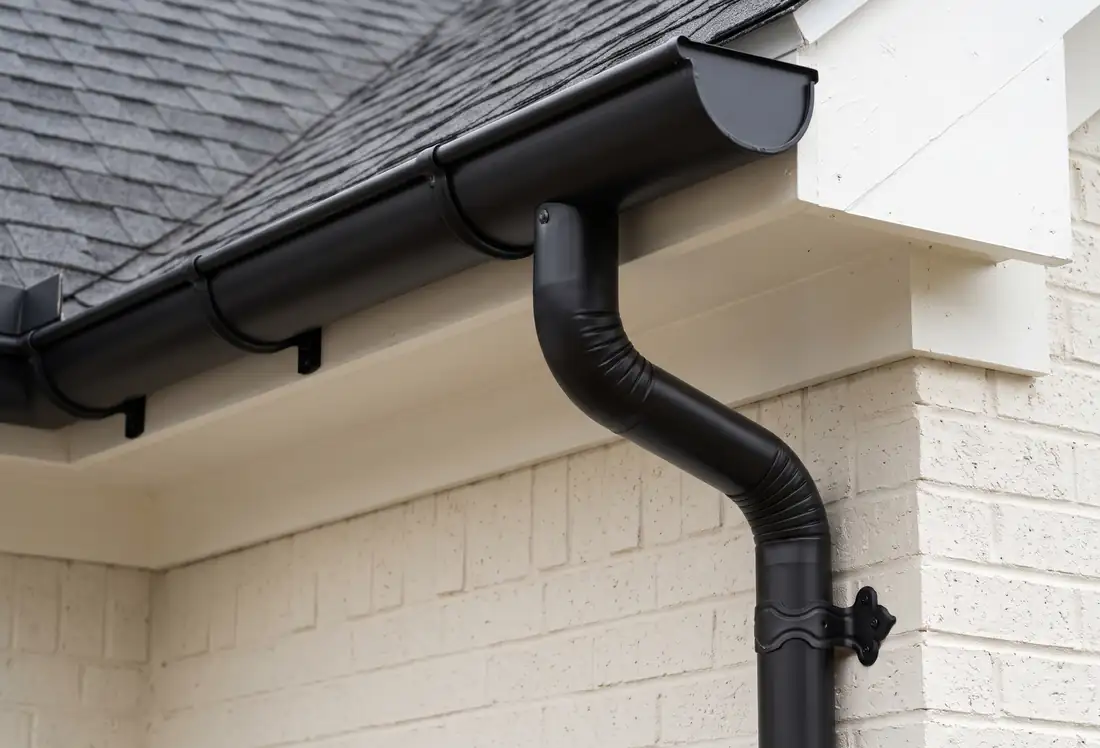
| Half-round | Open curved trough resting in hooks, typical of period buildings |
| Bracket | An exterior support, usually for half-round gutter, mounted to the fascia or the roof deck |
| Rafter tail | Where each sloping roof timber stops at the eave; the trim board is nailed across these ends |
| Outlet | The short tube through the trough floor that the pipe connects to |
| Downspout | The vertical pipe taking water from the gutter to the ground |
| End cap | The flat piece closing off each end of a run |
Choosing the metal
Prepainted aluminum delivers the curved look at a sensible price. Copper costs several times as much yet outlasts most owners, turning brown and later green with age. See copper gutters.
Town review
Changing the gutter material or profile on a building inside Leesburg's historic district may need sign-off. Ask the town before work is booked.
Carpentry comes first on older houses
Half-round often goes on houses that have been standing a long time, and older eaves rarely match modern assumptions. Fascia boards may be missing, uneven or covered in decades of paint. Rafter tails can be exposed and decorative. A careful installer checks each bracket location and replaces or sisters soft wood before any metal goes up. On historic buildings in Leesburg or old Herndon, the trim itself may be part of what the town wants preserved, so repairs should match the original profile.
Brackets and spacing
Each bracket carries the gutter from below, so spacing matters more than with hidden hangers. Closer spacing resists snow load and sliding ice, and it keeps the profile from flattening over time. Decorative cast brackets look good on a show front; plain brackets are fine on rear walls. Shank brackets fix to the roof deck under the shingles where there is no fascia to screw into, and they are best fitted when the roof is being replaced.
Capacity and downspouts
A half-round gutter holds less water than a K-style of the same width. On a modest roof that is rarely a problem, but on a large plane it can overflow in a summer downpour. The answer is usually a wider half-round, such as 6-inch, and more downspouts. Round downspouts in 3 or 4-inch carry the look down the wall, with matching elbows and straps.
Joining sections
Most half-round is sold in lengths and joined on site. Aluminum joints are sealed and riveted; copper joints are soldered. Soldered seams last far longer than sealant, which is one reason copper half-round is so durable. With aluminum, plan to reseal joints over the years as the sealant ages.
Mixing profiles on one house
Some homeowners use half-round on the front and K-style on the back where it cannot be seen. The two need their own corners and outlets, so they should not meet on the same run. Matching colors keeps the house looking consistent.
Questions to ask
- Which width will each eave get, and how many downspouts?
- Fascia, shank or rafter brackets, and at what spacing?
- Sealed or soldered joints?
- Will trim repairs be done first, and are they in the price?
- Does the town need to review the change on a historic building?
Looking after half-round
Half-round collects leaves like any gutter, but the open shape and bracket support make it a little easier to clean by hand. Check brackets each fall for any that have loosened or rusted, and look at joints after hard freezes. Aluminum half-round joints will need resealing every few years; copper soldered joints rarely do.