
Sections on this page
- Signs the whole system is done
- The replacement, start to finish
- Replacement vocabulary
- Worthwhile upgrades during replacement
- What does replacement cost?
- By neighborhood
- Replacing in stages
- Replacing in one visit
- Preparing for the crew
- What to check afterward
- Replacing part of the system
- Recycling and disposal
- When replacement is not the answer
- Timing replacement
- Replacement and the roof edge
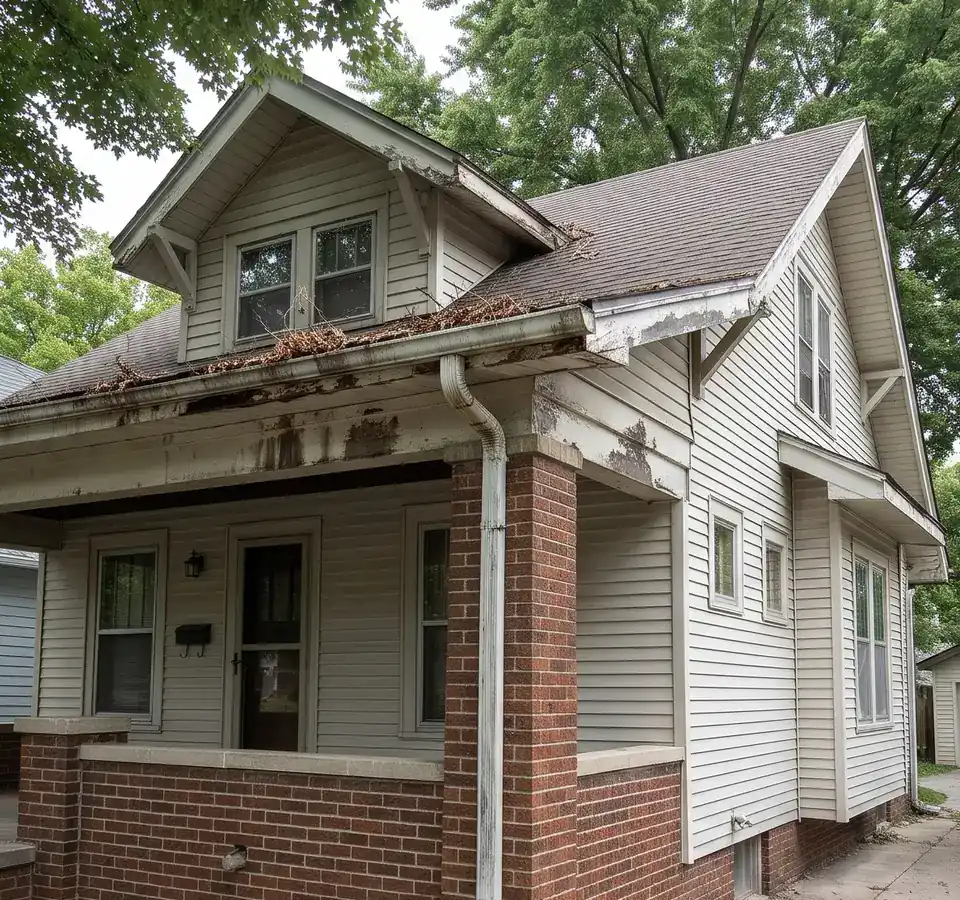
Signs the whole system is done
The tell is faults scattered around the house instead of in a single place.
| What you notice | What it tells you |
|---|---|
| Drips at most corners and seams | Sealant is failing across the system |
| Sags that come back after refastening | Fixings or fascia are failing |
| Corrosion, splits, metal worn thin | The trough has reached the end |
| Overflow on every big eave | The system is undersized for the roof |
| Patches on patches | Repairs are no longer good value |
| Soft fascia along long stretches | Water has been getting behind for years |
The replacement, start to finish
- Strip off the old troughs, nails, clips and pipes, and cart them off.
- Inspect fascia, soffit and rafter tails, and replace rotten wood.
- Fit drip edge where the roof edge has none.
- Re-size the system: often 6-inch on large rear eaves, 3x4 downspouts and extra drops near valleys.
- Form and hang new seamless runs on screwed hidden hangers.
- Fit downspouts and route each to an extension, splash block or cleared drain.
- Add guards if trees overhang.
- Test with water and clean up.
Replacement vocabulary
| Word | Meaning |
|---|---|
| Fascia | The horizontal board at the roof edge that the gutter is fastened to |
| Soffit | The panel or boards closing off the bottom of the roof overhang |
| Drip edge | A bent strip of metal fixed along the roof edge so water jumps clear of the wood and lands in the gutter |
| Coil | The roll of painted aluminum or steel fed through the seamless machine |
| Gauge | How thick the metal is: .027 or .032 inch for aluminum, sold by weight per square foot for copper |
| Hidden hanger | A bracket concealed inside the gutter that is screwed through the back wall into the fascia |
| Buried drain | Corrugated or PVC pipe under the lawn that carries downspout water to a pop-up, curb or ditch |
| HOA review | An architectural approval process many Loudoun communities require for exterior changes, including gutter color |
Worthwhile upgrades during replacement
| Original setup | Upgrade | Why |
|---|---|---|
| 5-inch on a big two-story roof | 6-inch K-style | Handles summer downpours |
| 2x3 downspouts under oaks | 3x4 downspouts | Fewer clogs |
| Spike and ferrule | Screwed hidden hangers | Holds under snow and wet leaves |
| No drip edge | Drip edge or gutter apron | Stops water running behind |
| Downspouts emptying at the wall | Extensions or buried drains | Keeps basements and crawl spaces dry |
| No guards under trees | Micro-mesh | Fewer cleanings |
What does replacement cost?
Replacement prices track new-install averages: about $9–13 a foot for 5-inch aluminum and $12–18 for 6-inch, per Angi and This Old House. Removal, fascia repair, extra downspouts and guards are often separate lines on the quote.
Rough out your price
$1,440 to $2,240
A planning figure drawn from national cost guides by Angi, This Old House. The real number depends on corners, downspouts, trim repair and access, and comes from a contractor who measures the house.
By neighborhood
Sterling Park's 1960s homes are often on their second or third system and need fascia work. Sugarland Run and Countryside homes from the 1970s and 1980s commonly have original gutters near the end of their life. Cascades and Ashburn homes from the 1990s are now reaching that point. See replacing original builder gutters.
Replacing in stages
Some owners replace the worst eaves first, often the rear of a two-story house under trees, and do the rest later in the same color and profile.
Replacing in one visit
Most full replacements on a typical house in eastern Loudoun are done in a day. The crew removes the old gutters and downspouts, checks and repairs fascia, adds drip edge where it is missing, forms and hangs the new gutters and fits downspouts and extensions. Larger houses, steep lots and extensive fascia repairs can stretch it to two days. Dry weather is best, so dates can move if storms are forecast.
Preparing for the crew
- Move cars from the driveway so the trailer can park close.
- Clear patio furniture, grills and planters from under the eaves.
- Keep pets indoors while ladders are up.
- Point out buried drains and pop-ups so they are reconnected.
- Have the association approval on hand if required.
What to check afterward
Walk around once the crew is done. Gutters should be straight with a gentle fall to each outlet. Corners should be neat and sealed. Downspouts should be strapped into the wall with extensions pointing away. The old gutters and debris should be gone. Then check again in the first heavy rain.
Replacing part of the system
If only one side has failed, that side can be replaced in matching color and profile. Ask the contractor to bring a sample to compare against the existing gutters, because older coil may have faded. Over time the colors usually even out.
Recycling and disposal
Old aluminum gutters are recyclable. Ask whether removal and disposal are included, and whether the metal will be recycled.
When replacement is not the answer
Some systems look worse than they are. A thorough cleaning, resealing and rehang can bring a sound system back for several more years. A good contractor will say so if repairs are the better value.
Timing replacement
Late spring and summer are good times to replace gutters. Contractors are often less busy than in fall, the weather is reliable and there is time for any association approval before leaves come down. Replacing ahead of fall also means the new system faces its first heavy leaf drop with clear outlets and sound fixings. If the gutters have failed and are causing damage, though, it is better not to wait.
Replacement and the roof edge
New gutters are only as good as the roof edge above them. If drip edge is missing or bent, water can run behind even a new gutter. Ask the contractor to check the roof edge and include new drip edge or gutter apron where needed. It is a small cost compared with fascia rot later.