
Sections on this page
Reading the droop
| Location of the dip | Probable reason | Fix |
|---|---|---|
| Mid-run on a long wall | Clips spaced wide; heavy debris | More clips, then clean |
| The full length | Nails backing out | Rehang with screws |
| Near a miter | Soft trim or a loose corner | New board, refix the corner |
| Below a tree | Limb hit or snow weight | Straighten or swap the piece |
| Beside a drop | Water weight at the hole | Extra clip either side |
Rehang sequence
- Empty the trough so the real line shows.
- Probe the trim and swap out any soft boards.
- Snap a chalk line that falls gently to each drop.
- Pull the old nails and their sleeves.
- Drive concealed screw clips about two feet apart, tighter on exposed walls.
- Recaulk any seam that moved.
- Run water and watch it reach the drop.
Sag vocabulary
| Word | Meaning |
|---|---|
| Spike and ferrule | Old-style fixing: a nail pushed through a tube spanning the trough and into the trim |
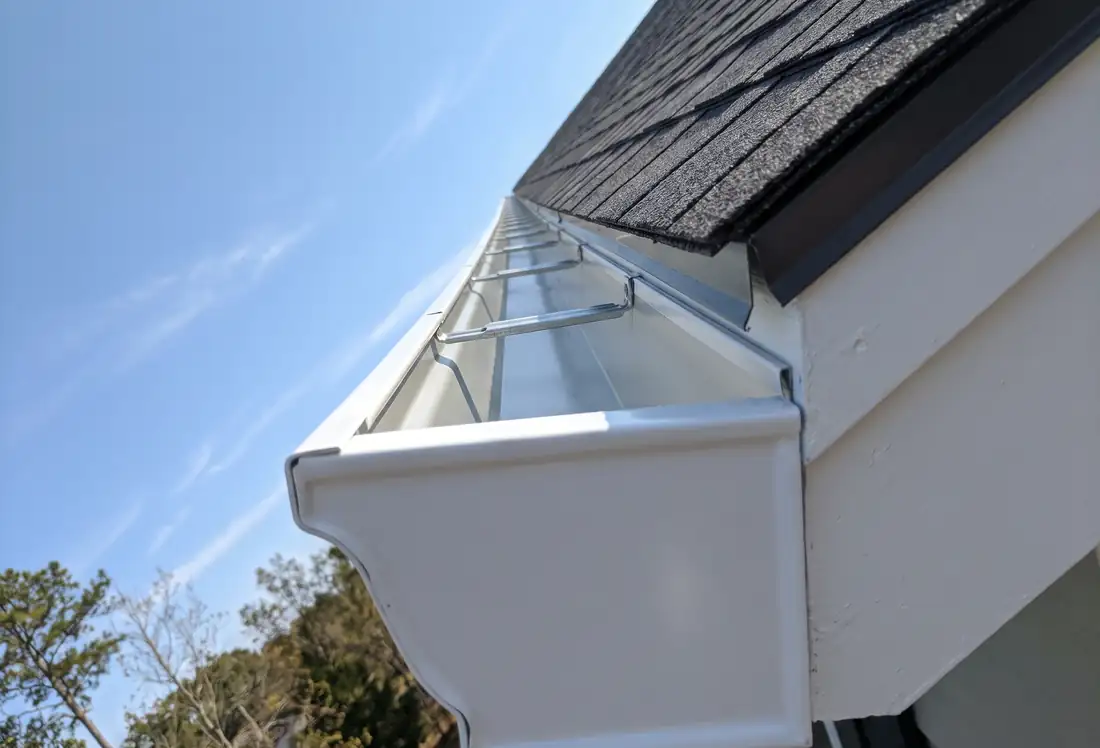
| Hidden hanger | A bracket concealed inside the gutter that is screwed through the back wall into the fascia |
| Fall | The slight downward slope of a gutter toward its outlet |
| Fascia | The horizontal board at the roof edge that the gutter is fastened to |
| Rafter tail | Where each sloping roof timber stops at the eave; the trim board is nailed across these ends |
| Ice dam | A ridge of ice along the eaves that holds back meltwater after snow |
Winter loads
Snow sheeting off a roof, plus ice packed in the trough, is heavy. The January 2016 blizzard put 22.1 inches on Dulles in one day, and storms like that are hard on nail-hung gutters, while screw clips in good wood usually hold.
If the dip returns quickly
A run that sinks again within months almost always has soft trim; screws simply have nothing to bite. See fascia and soffit repair.
Rehang versus new
Sound metal only needs rehanging. Metal that is also dented and dripping along its length is usually better replaced.
The cycle a sag starts
A small dip holds water after every rain. That water adds weight, so the dip deepens. Debris settles in the low spot, holding more water and more weight. In winter the standing water freezes, adding still more load and pushing on the fixings. Meanwhile the gutter overflows at the low point, soaking the fascia behind it, which softens the wood the hangers depend on. Catching a sag early keeps it to a quick rehang.
Spikes and why they fail
Many older houses around Sterling still have gutters held with long spikes through a tube called a ferrule. As the fascia swells in humid summers and dries in winter, the spike works its way out a little each year. Eventually the gutter hangs from a few spikes that still grip, and the runs between them droop. Hidden hangers with screws hold much better, because the threads grip the wood instead of relying on friction.
Slope and how it is set
A gutter should fall gently toward each outlet, about a quarter inch over ten feet. Too little slope and water sits; too much and the gutter looks crooked against the roof line. Long runs are often sloped from the middle to downspouts at both ends, which keeps the drop small. When rehanging, a chalk line along the fascia is the guide for every hanger.
Corners and outlets
Sags often start where a corner joint has loosened or where the weight of water at an outlet pulls the gutter down. Corners may need re-riveting and resealing, and outlets can be supported with an extra hanger on each side.
Trees and branches
Limbs resting on a gutter, or dropping onto it in storms, bend the front lip and pull the back from the fascia. If a sag is under a tree, trimming the limb back is part of the fix. Otherwise the problem returns with the next storm.
Signs to watch for
- A dip in the gutter line visible from the street.
- A gap between the back of the gutter and the fascia.
- Water spilling at one point while the rest of the gutter stays dry.
- Spike heads standing out from the gutter face.
- Ice building up in one stretch in winter.
When a whole system needs rehanging
If sags appear in several places at once, the fixings throughout the house are probably failing together. That is common on homes with original spike-fixed gutters. Rehanging every run on screwed hangers in one visit costs less than chasing sags one at a time.