
Sections on this page
The styles side by side
| Style | Principle | Seeds and flowers | Leaves |
|---|---|---|---|
| Micro-mesh | Tight stainless weave in a frame | Held out | Held out |
| Perforated cover | Sheet punched with holes | Partly get through | Held out |
| Screen | Open grid | Get through | Mostly held out |
| Reverse-curve hood | Water clings round a curved nose | Collect at the slot | Slide off |
| Foam insert | Porous block filling the trough | Caught inside | Sit on top |
| Brush insert | Bristles filling the trough | Snag in bristles | Snag on top |
Deciding
- Name the trees that hang over the roof.
- Think about how tall and awkward the eaves are to reach.
- Confirm the gutters themselves are in good shape.
- Line up per-foot prices on identical footage.
- Ask how each style mounts and how it lifts off for cleaning.
- Check association rules on guards seen from the street.
Guard vocabulary
| Word | Meaning |
|---|---|
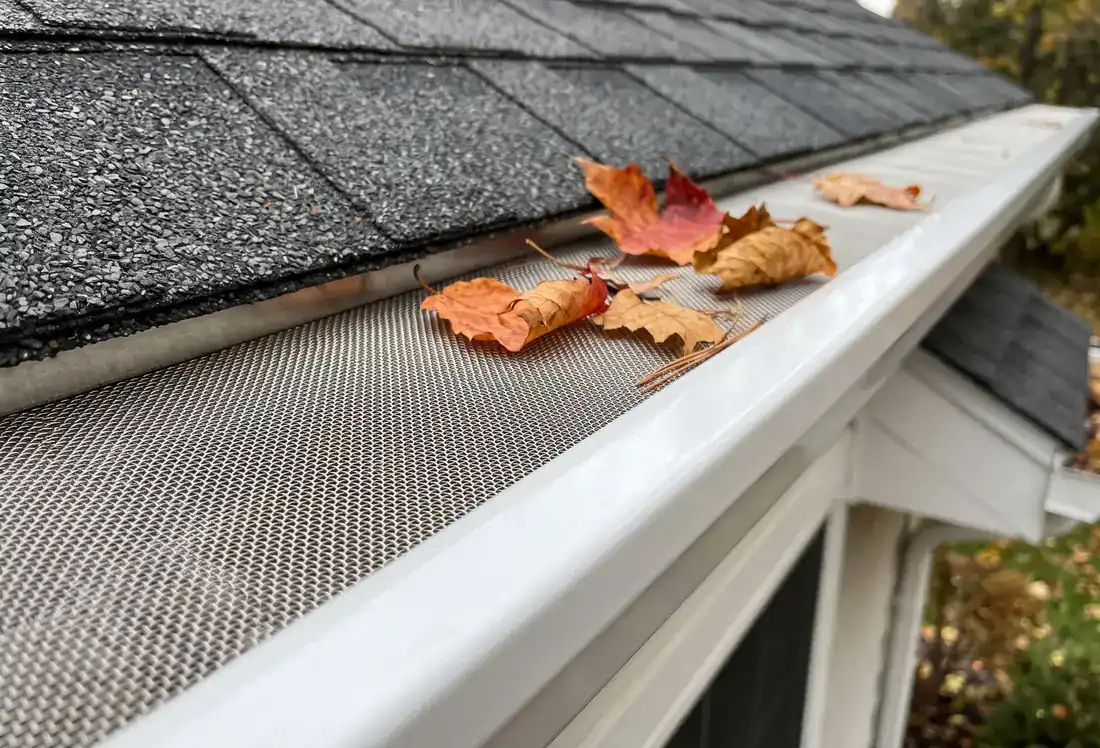
| Micro-mesh | Fine stainless mesh over a frame that blocks small debris like oak flowers and pine needles |
| Perforated cover | A guard with punched holes that lets water through |
| Reverse curve | A hood-style guard where water wraps around a curved lip into the gutter |
| Gutter apron | L-shaped metal tucked beneath the first shingle course, its lower leg hanging into the trough |
| Outlet | The short tube through the trough floor that the pipe connects to |
| HOA review | An architectural approval process many Loudoun communities require for exterior changes, including gutter color |
Hoods and curb appeal
A reverse-curve hood hides the whole trough behind a rounded nose. Some houses wear that well; on others it looks heavy. Ask for pictures from a similar house and check with the association.
Where a basic screen will do
Sheds, garages and open single-story eaves with only a few leaves can manage with a screen. Under oaks and maples, or where every cleaning costs a ladder crew, mesh tends to pay for itself.
Changing style
Old screens or inserts have to come out and the troughs cleaned before anything new goes on. Check that is in the price.
Matching the guard to the trees
The trees overhead decide most of the choice. Big leaves from tulip poplars and sycamores sit on top of nearly any guard. Small debris, such as oak catkins, maple seeds and pine needles, is what separates the options. Perforated covers and screens let much of it through, foam traps it and brushes tangle it. Fine mesh keeps it out. Under a mix of large and small debris, as on many lots around Sterling, mesh is the most reliable.
Height and access
On a single-story rambler where gutters can be reached from a short ladder, simple screens and regular cleaning may be enough. On a two-story colonial, especially one backing onto woods in Cascades or Lowes Island, every cleaning means a tall ladder, so a guard that cuts cleaning to a rare brush is worth more.
Inserts
Foam and brush inserts sit inside the gutter. They are cheap and easy to fit, but debris collects in and on them, and they need to be pulled out and cleaned. Foam can also hold moisture and grow moss. Most contractors do not recommend them for heavily treed lots.
Hoods
Reverse-curve hoods cover the gutter completely. Water follows the curved nose into a slot, and leaves slide off. They handle large leaves well but can let small debris collect in the slot, and in very heavy rain water can overshoot the nose. They change the look of the eave more than mesh does, which may matter to an association.
Screens and perforated covers
These are flat panels with holes or a grid. They keep out most leaves at a low price. Seeds and small debris get through, so gutters still need cleaning, though less often. They are a sensible option on garages, sheds and open eaves.
A simple way to decide
- Under oaks, maples or pines, choose fine stainless mesh.
- Under only large-leafed trees, a cover or hood may be enough.
- On low, open eaves, a screen and occasional cleaning can work.
- Avoid foam and brush inserts on heavily treed lots.
- Check association rules before choosing a visible hood.
Guards and winter
No guard stops ice. In a cold snap, meltwater can freeze on top of mesh or covers and in the trough below. Guards that are screwed down stay in place when snow slides over them; loose clip-in screens can be pushed off. On eaves where snow slides off every winter, ask how the guard is fastened and whether the gutter hangers are strong enough for the combined load. A guard that comes off in the first big snowfall is money lost.